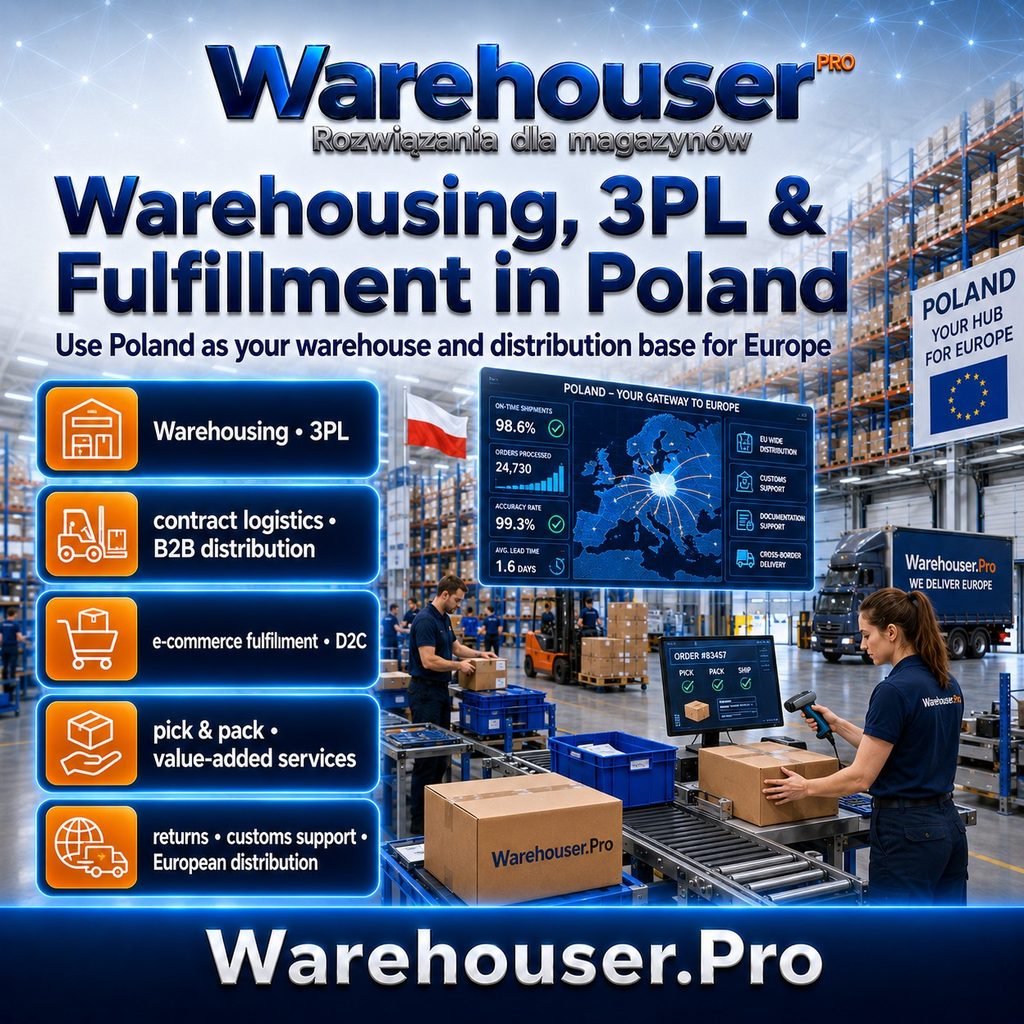
Warehouser™ Warehousing, 3PL & Fulfillment in Poland
Use Poland as your warehouse and distribution base for Europe
Warehousing • 3PL • contract logistics • B2B distribution • e-commerce fulfillment • D2C • pick & pack • value-added services • returns • customs support • European distribution
You manufacture products outside Poland.
Your customers are in Poland, Germany, Central Europe or across the European Union.
You do not necessarily need to build your own warehouse, recruit your own warehouse team or create an entire logistics organisation from scratch.
You may need something much simpler:
a reliable logistics operation in Poland that receives your goods, stores them, processes orders and distributes them to your customers across Poland and Europe.
This is the international role we are developing for Warehouser™.
Warehouser is designed to become a first point of contact for international companies looking for warehousing and logistics operations in Poland.
Tell us what you sell, where your products come from, where your customers are and how your distribution model works.
We help translate this into a structured warehouse requirement and identify the type of Polish 3PL, fulfillment operator, contract logistics provider or specialist warehouse operation that should handle it.
Your products → Poland → Warehousing → Order Fulfillment → European Distribution
[Find a Warehouse Partner in Poland →]
[Submit a Poland Logistics RFQ →]
Your European distribution operation can start in Poland
Imagine you are a manufacturer based in:
- China,
- South Korea,
- Japan,
- India,
- Türkiye,
- the United States,
- the United Kingdom,
- another European or non-European country.
Today you ship individual orders or pallets over long distances.
Instead, you want to position inventory closer to European customers.
A possible model is:
factory
↓
container / truck / rail / air shipment
↓
Poland
↓
warehouse / 3PL
↓
inventory
↓
B2B / B2C / D2C orders
↓
Poland + Germany + EU
↓
returns / replenishment / value-added services
You remain focused on manufacturing and sales.
The logistics operation is performed locally.
Why Poland?
Poland is increasingly positioned as a manufacturing and logistics hub for companies serving European markets.
The Polish Investment and Trade Agency highlights Poland’s location, EU market access, industrial infrastructure, qualified workforce and developed logistics sector when promoting the country to international investors, including Asian companies looking for a European base.
This is not merely a theoretical investment proposition.
In April 2026, DHL Supply Chain launched a major logistics operation for Oriflame in Central Poland. The Polish site serves simultaneously as a global hub and a regional distribution centre, handling worldwide shipments and B2C distribution to multiple European markets.
Other logistics operators explicitly market Polish facilities as European distribution bases. PostNord, for example, positions its warehouse near Poznań as a location for serving both Western and Eastern European markets.
For an international company, the strategic question is therefore not only:
Should we sell in Poland?
It may be:
Should Poland become our physical inventory and distribution base for Europe?
Warehouser™ Poland Logistics Gateway
Warehouser does not need to own every warehouse.
Our role is different.
We want to become the gateway between an international company’s logistics requirement and the Polish warehousing market.
The process can look like this:
1. YOU DESCRIBE THE BUSINESS
What do you manufacture or sell?
Where are the goods coming from?
Where are your customers?
What volumes do you expect?
2. WE DEFINE THE LOGISTICS REQUIREMENT
We translate the commercial situation into warehouse parameters.
For example:
pallets
SKU
inventory
orders/day
B2B / B2C / D2C
countries served
storage requirements
packing requirements
returns
customs
integrations
3. WE IDENTIFY THE RIGHT OPERATING MODEL
Depending on the requirement, the correct solution may be:
shared-user warehouse
dedicated warehouse operation
3PL
contract logistics
e-commerce fulfillment
B2B distribution centre
bonded warehouse
temperature-controlled warehouse
or a specialised logistics operation.
4. POLAND LOGISTICS RFQ
The requirement becomes a structured Direct RFQ™ that can be matched with relevant operators or specialist partners.
5. OPERATING PARTNER
The selected partner can then provide the actual warehouse and logistics operation.
Need → Logistics Model → Poland → Operator Match → Direct RFQ™ → Operation
What can a Polish warehouse operator do for your company?
The exact scope depends on the project.
A full logistics operation can potentially include much more than storing pallets.
Inbound logistics
Your inventory first needs to enter the Polish warehouse operation.
Depending on the supply chain, this may involve:
- container arrivals,
- full truck loads,
- less-than-truckload shipments,
- pallet deliveries,
- parcel deliveries,
- inbound booking,
- unloading,
- quantity verification,
- receiving,
- quality checks,
- stock registration,
- put-away.
For goods arriving from outside the European Union, the project may also require appropriate customs and import support.
Warehouser can help identify whether this needs to be part of the logistics requirement.
Warehousing
The basic requirement may involve:
- pallet storage,
- shelf storage,
- bin storage,
- bulk storage,
- short-term storage,
- long-term storage,
- overflow storage,
- shared-user warehousing,
- dedicated warehouse space.
The right model depends on the inventory profile.
A business holding 40 pallets and shipping 20 orders per day requires a different operation from a manufacturer holding 6,000 pallets and distributing full-pallet orders to retailers across Europe.
Inventory management
A warehouse is not simply physical space.
The operator may also manage:
- inventory records,
- batch information,
- serial numbers,
- expiry dates,
- FIFO,
- FEFO,
- stock availability,
- replenishment,
- cycle counting,
- inventory reporting.
Modern outsourced warehousing increasingly combines physical storage with digital inventory visibility. DHL, for example, offers warehousing models combining inventory management, order processing, e-fulfillment, packaging and delivery management.
B2B distribution
International manufacturers often do not need classic e-commerce fulfillment.
They may need to distribute:
- full pallets,
- mixed pallets,
- cartons,
- components,
- retail orders,
- distributor orders,
- dealer orders,
- wholesale orders.
The Polish warehouse becomes the European stock point.
Example:
manufacturer in Korea
↓
bulk shipment to Poland
↓
Polish warehouse
↓
distributor Germany
customer Czech Republic
retailer Poland
partner Lithuania
dealer France
The exact distribution model becomes part of the RFQ.
B2C and D2C fulfillment
If you sell directly to consumers, the logistics operation may include:
order import
↓
picking
↓
packing
↓
labelling
↓
carrier selection
↓
shipment
↓
tracking
↓
returns.
Large logistics providers operating in Poland already offer models combining warehousing, pick & pack, B2C/B2B/D2C fulfillment and return management.
Polish fulfillment providers also increasingly market an explicit model for companies outside the country:
world → Poland → EU
with goods received, stored, packed and distributed from a Polish warehouse without the foreign brand building its own physical warehouse infrastructure.
E-commerce fulfillment
For an international e-commerce brand, the Polish operation may support orders originating from:
- Shopify,
- WooCommerce,
- Amazon,
- Allegro,
- Kaufland,
- marketplaces,
- proprietary stores,
- ERP systems,
- other sales platforms.
The warehouse can become the execution layer behind those channels.
The integration requirement should therefore be defined before operator selection.
Pick & pack
The simplest fulfillment process looks like:
order
↓
pick
↓
pack
↓
ship.
But real operations may require:
- single-item picking,
- multi-item orders,
- batch picking,
- carton selection,
- protective packaging,
- branded packaging,
- inserts,
- documents,
- gift wrapping,
- special labelling.
This should be included in the operational specification.
Value-Added Services — VAS
Some products require additional work after arriving in Poland.
A logistics operator may potentially perform operations such as:
- labelling,
- relabelling,
- kitting,
- assembly,
- repacking,
- bundling,
- inserting documentation,
- product configuration,
- quality inspection,
- promotional sets,
- display preparation,
- customised packaging.
Global contract logistics operators treat these services as a distinct part of the warehouse value chain. DSV, for example, lists kitting, assembly, testing, packaging, repackaging, configuration, customisation, labelling, repairs and quality inspection among contract-logistics value-added services.
This can be extremely important for a foreign manufacturer.
The warehouse is no longer only:
a place where products wait.
It becomes:
a local operational layer preparing products for the European market.
Packaging in Poland
Products may arrive in bulk packaging but require different packaging for European distribution.
The warehouse operation may therefore need access to:
- cartons,
- stretch film,
- tapes,
- strapping,
- protective packaging,
- labels,
- pallet materials,
- returnable transport packaging.
This is where the international logistics layer connects naturally with the existing Warehouser ecosystem:
[Packaging Materials →]
[Packaging Machines →]
[PPWR Ready →]
Returns management
European distribution does not end when the package reaches the customer.
A scalable operation may need:
- return address,
- return receiving,
- product identification,
- inspection,
- classification,
- restocking,
- repacking,
- quarantine,
- disposal or recycling routing,
- repair routing.
Returns are especially important in e-commerce but can also matter in spare parts, retail, electronics and B2B distribution.
Large fulfillment networks already treat returns as a core part of the service rather than an exception.
Cross-border distribution from Poland
A Polish warehouse can serve more than the Polish domestic market.
Depending on operator location, carrier network, products and service level, the same inventory can support multiple European destinations.
A western Poland logistics operator, for example, markets fulfillment from one Polish centre with rapid access to Germany and delivery across EU markets, combined with a local German returns process.
This creates a strategic model:
one inventory pool → multiple European markets.
Instead of maintaining separate stock in several countries, some companies may be able to centralise part of their inventory in Poland.
Whether this is appropriate depends on delivery requirements, taxation, customs, product characteristics and customer geography.
Poland → Germany
Germany deserves particular attention.
For many international companies, Poland can serve simultaneously as:
- a large domestic market,
- a Central European distribution location,
- a logistics base close to Germany.
A project serving Germany from Poland should analyse:
- warehouse location,
- target German regions,
- parcel or pallet profile,
- carrier cut-off times,
- required delivery times,
- returns,
- B2B versus B2C,
- inventory profile.
Warehouser does not assume that every operation should be located close to the German border.
For some supply chains Central Poland may provide a better balance between domestic and European distribution.
The location should follow the network.
Customs and bonded warehousing
For manufacturers outside the EU, customs can be one of the most important parts of the project.
Depending on the goods and operating model, the logistics solution may need access to:
- customs brokerage,
- import procedures,
- export procedures,
- temporary storage,
- bonded warehousing,
- documentation support.
There are Polish operators already combining warehousing, fulfillment, cross-border transport and customs or bonded-storage services.
Warehouser itself should not replace a licensed customs representative.
Our role is to recognise when customs capability is part of the requirement and route the project to an appropriate specialist operator.
Specialised warehousing
Not every product can be placed in a standard warehouse.
A project may require specialised conditions.
Examples include:
FOOD
appropriate food-storage requirements.
PHARMA / HEALTHCARE
controlled procedures and potentially temperature-controlled environments.
COLD STORAGE
chilled or frozen goods.
DANGEROUS GOODS
special storage and transport requirements where applicable.
HIGH-VALUE PRODUCTS
enhanced security.
OVERSIZED GOODS
non-standard storage and handling.
FASHION
high SKU counts, returns and seasonal peaks.
SPARE PARTS
high availability requirements and urgent distribution.
A pharmaceutical example already exists in Poland at European scale: CEVA operates GSK’s Robakowo distribution centre as one of four strategic European hubs distributing vaccines and pharmaceuticals to seven Central and Northern European countries.
Shared-user or dedicated operation?
This is one of the first decisions to make.
SHARED-USER WAREHOUSE
Several clients use the same logistics infrastructure.
Potential advantages:
- lower entry barrier,
- shared resources,
- scalability,
- faster implementation,
- suitable for smaller or variable volumes.
DEDICATED OPERATION
The warehouse operation is designed primarily for one client.
Potentially relevant when:
- volumes are large,
- operations are complex,
- specialised automation is required,
- a large dedicated workforce is needed,
- the business requires customised processes.
DHL describes both shared and dedicated warehousing models as part of its contract-logistics offer.
You do not need your own warehouse in Poland
This is a core Warehouser message.
A foreign manufacturer can build its European presence in stages.
STAGE 1
Export individual orders from the home country.
STAGE 2
Place inventory with a Polish fulfillment or 3PL operator.
STAGE 3
Develop local B2B/B2C distribution.
STAGE 4
Add dedicated processes, VAS and integrations.
STAGE 5
Move to dedicated space or a dedicated operation if volumes justify it.
STAGE 6
Automate selected operations.
You do not need to start at Stage 5.
Warehousing before investment
This makes Poland especially interesting for companies testing the European market.
Instead of immediately:
leasing a warehouse
buying equipment
hiring staff
implementing WMS
negotiating carrier contracts
a company may first outsource the operation.
That lowers the operational threshold for establishing a physical inventory presence in Europe.
If the business grows, the logistics model can evolve.
Who is this service for?
INTERNATIONAL MANUFACTURERS
who want inventory closer to European customers.
FOREIGN E-COMMERCE BRANDS
looking for a fulfillment base inside the EU.
B2B SUPPLIERS
that need pallet and carton distribution across Poland and Europe.
ASIAN COMPANIES ENTERING EUROPE
looking for an operational gateway into the EU market.
UK / US COMPANIES
that need a European logistics base.
EUROPEAN MANUFACTURERS
looking to consolidate inventory or move selected logistics operations to Poland.
COMPANIES TESTING POLAND
that do not yet want their own warehouse infrastructure.
Warehouser does not sell one warehouse
That is critical to our model.
If Warehouser represented only one facility, every requirement would receive the same answer:
use this warehouse.
That is not what we want to build.
The correct question is:
Which warehouse operating model best fits this particular supply chain?
A 3PL suitable for cosmetics may not be right for machine parts.
An e-commerce fulfillment centre may not be right for pallet distribution.
A central Poland hub may not be optimal for every Germany-focused project.
A small shared warehouse may be better than a global logistics operator for one customer — and completely wrong for another.
Warehouser should therefore act as an independent discovery and RFQ layer.
Warehouse Operator Match
Our long-term model is:
DISCOVER
Identify operators potentially able to handle the requirement.
MATCH
Compare their declared capabilities with the project.
VERIFY
Confirm critical information.
RFQ
Send the structured requirement.
COMPARE
Compare offers on the same operational basis.
This is much more useful than a directory containing hundreds of warehouse addresses.
What should we compare?
Warehouse outsourcing should not be compared only on price per pallet.
Depending on the project, we may analyse:
- location,
- storage type,
- pallet capacity,
- order profiles,
- B2B / B2C capability,
- cut-off times,
- receiving capacity,
- picking model,
- packing,
- carrier network,
- European distribution,
- returns,
- value-added services,
- customs capability,
- WMS,
- API/integrations,
- reporting,
- scalability,
- seasonality,
- security,
- special certifications,
- implementation lead time,
- SLA,
- pricing model.
Only then do offers become meaningfully comparable.
Warehouser™ Poland Logistics RFQ
You do not need to prepare a professional warehouse tender yourself.
Start with what you know.
COMPANY
Country of origin
Industry
Website
Products
PRODUCTS
Number of SKU
Dimensions
Weight
Pallet/carton/unit
Special requirements
INBOUND
Country of origin
Container / truck / pallet / parcel
Expected inbound frequency
INVENTORY
Average pallets / units
Peak inventory
Seasonality
ORDERS
Orders per day / month
Order lines
Units per order
B2B / B2C / D2C
MARKETS
Poland
Germany
CEE
EU
Other
SERVICES
Storage
Pick & pack
Pallet distribution
Packing
Labelling
Kitting
Returns
Customs
Quality inspection
Other
INTEGRATION
ERP
Shop
Marketplace
API
EDI
Other
PROJECT
Target launch date
Preferred region — if known
Current logistics model
Main problem to solve
What if you do not know the answers?
That is normal.
A foreign manufacturer may know:
We expect approximately 1,500 orders per month and want to serve Germany, Poland and Czechia from one location.
That can be enough to begin qualification.
Warehouser can help determine which additional parameters are required before the request goes to operators.
This follows the same principle we use throughout Warehouser:
minimum RFQ payload.
Ask only for the information required for the next useful decision.
A practical example
THE COMPANY
A manufacturer in South Korea.
THE PRODUCT
Consumer goods currently shipped individually from Asia.
THE OBJECTIVE
Launch faster distribution in Poland and Germany and later expand across the EU.
POSSIBLE MODEL
factory in Korea
↓
bulk shipment
↓
Polish 3PL warehouse
↓
customs/import process where applicable
↓
stock in Poland
↓
Shopify / marketplace / distributor orders
↓
pick & pack / B2B pallet preparation
↓
DPD / DHL / GLS / freight network
↓
Poland / Germany / EU
↓
returns to local European operation
The manufacturer gains a European logistics layer without initially building its own warehouse organisation.
That is exactly the kind of requirement Warehouser should qualify.
A second example — industrial B2B
THE COMPANY
A machinery-component manufacturer outside the EU.
REQUIREMENT
Maintain inventory in Europe and supply distributors and factories within short lead times.
MODEL
bulk inbound shipment
↓
pallet storage in Poland
↓
inventory management
↓
B2B order
↓
carton / pallet picking
↓
European road distribution
↓
urgent spare-part shipment if required
Here classic e-commerce fulfillment may be irrelevant.
The correct partner is likely a B2B contract-logistics operator.
Warehouser should recognise that difference.
A third example — e-commerce
THE BRAND
An international online brand entering the EU.
REQUIREMENT
Local stock, parcel fulfillment and returns.
MODEL
inventory into Poland
↓
WMS / shop integration
↓
order
↓
pick & pack
↓
cross-border parcel
↓
customer in Poland / Germany / EU
↓
European return
This is a classic fulfillment requirement.
One Polish base, multiple markets
The strategic value proposition is simple:
Stock once. Serve multiple European markets.
Not every company will be able to centralise all European inventory in Poland.
But for the right supply chain, Poland can become:
- a Polish distribution centre,
- a CEE hub,
- a Germany-facing warehouse,
- an EU e-commerce fulfillment base,
- a European spare-parts hub,
- a regional B2B distribution centre.
The choice depends on the customer network.
Poland Gateway — not only a warehouse
Once a foreign company operates inventory in Poland, other needs appear.
Warehouser already has the architecture to support them.
PACKAGING
Stretch film, tapes, cartons, strapping and packaging optimisation.
[Packaging Materials →]
PACKAGING EQUIPMENT
Wrappers, strapping machines, carton sealers and other end-of-line equipment.
[Packaging Machines →]
WAREHOUSE EQUIPMENT
Racking, workstations, containers and handling equipment.
[Warehouse Equipment →]
AUTOMATION
AMR, AGV, robotics, AS/RS, Machine Vision and WMS/WES/WCS.
[Warehouse Automation →]
PPWR READY
Packaging and transport-packaging readiness.
[PPWR Ready →]
SERVICE & SPARE PARTS
Maintenance, spare parts, retrofit and downtime support.
[Service & Spare Parts →]
This is why international warehousing fits Warehouser so well.
The warehouse relationship becomes the entry point to the rest of the ecosystem.
From 3PL selection to warehouse optimisation
A client may first come to Warehouser with a simple requirement:
We need a warehouse in Poland.
Later the same operation may require:
slotting
packing optimisation
PPWR readiness
automation
AMR
new packaging
spare parts
maintenance
additional warehouse locations.
Warehouser can therefore remain useful throughout the lifecycle of the logistics operation.
Why Warehouser instead of searching for “3PL Poland”?
Because the buyer does not really need a list of 50 logistics companies.
The buyer needs an answer to:
Which type of operator fits our supply chain and which companies are actually worth asking?
Search creates candidates.
Warehouser aims to create qualified demand.
Warehouser™ as your first logistics contact in Poland
Our international ambition is straightforward.
When a company outside Poland thinks:
We want to store and distribute our products from Poland.
we want the next thought to be:
Ask Warehouser.
We do not have to operate every truck, warehouse or customs process ourselves.
We need to understand the requirement well enough to connect it with the right Polish logistics capability.
That is our role:
FIRST CONTACT
↓
REQUIREMENT
↓
POLAND LOGISTICS MAP
↓
OPERATOR MATCH
↓
DIRECT RFQ™
↓
WAREHOUSE OPERATION
Looking for warehousing in Poland?
Tell us:
What products do you sell?
Where are they coming from?
How much inventory do you expect?
How many orders do you process?
B2B, B2C or both?
Which European countries do you want to serve?
What additional warehouse services do you need?
We will use this information to structure your requirement and identify the appropriate type of logistics operation in Poland.
Warehouser™ Poland Logistics Gateway
Your products. Polish warehouse infrastructure. European distribution.
[FIND A WAREHOUSE PARTNER IN POLAND →]
[SUBMIT POLAND LOGISTICS RFQ →]
FAQ
Can a foreign company store products in Poland and distribute them across Europe?
Yes, this operating model is already used by international businesses. The exact structure depends on the company’s origin, goods, customs and tax situation, distribution markets and service requirements. Warehouser focuses on identifying the appropriate warehousing and logistics operating model; formal customs, tax and legal matters should be handled by qualified specialists.
Do I need my own warehouse in Poland?
No. A company can outsource warehousing and logistics to a 3PL, fulfillment or contract-logistics operator instead of initially building its own warehouse infrastructure.
Can one warehouse serve Poland and other EU countries?
Potentially yes. Polish logistics operations already serve multiple European markets from a single inventory base. The viability of this model depends on target countries, required delivery times, order profile and product characteristics.
What is the difference between fulfillment and contract logistics?
Fulfillment usually focuses heavily on order processing, picking, packing, parcel shipping and returns, particularly for e-commerce and D2C. Contract logistics can cover broader and more customised warehousing and distribution operations, including B2B, pallets, dedicated processes and value-added services.
Can Warehouser help with B2B distribution?
Yes. The requirement does not need to involve e-commerce. It can cover full pallets, mixed pallets, cartons, distributor replenishment, retail deliveries or spare-parts distribution.
Can the warehouse perform labelling and repacking?
Many 3PL and contract-logistics operators offer value-added services such as labelling, repacking, kitting, assembly, quality inspection and product customisation. The exact capability needs to be verified for each operator.
What about customs for goods arriving from outside the EU?
If customs services are required, this should be included in the RFQ and routed to an operator or specialist with the appropriate capabilities. Warehouser itself does not replace a licensed customs representative.
Can Warehouser find cold-storage or specialised warehousing?
This can be handled as a specialist requirement. Temperature control, pharmaceuticals, food, dangerous goods, oversized products and other specialist categories need to be matched to appropriately qualified operators.
Do I need to establish a Polish company first?
That depends on the commercial, tax, customs and legal structure of the project. Warehouser should not provide a universal answer. We can identify the logistics requirement, while company formation, VAT, importer-of-record and other formal questions should be assessed by appropriate professional advisers.
Can we start with a small amount of inventory?
Potentially yes. Shared-user 3PL and fulfillment models can provide a lower entry threshold than building a dedicated operation. Suitability depends on the product and volumes.
Szybki kontakt z Warehouser™ — rozwiązania dla magazynów.
Opisz, czego potrzebuje Twój magazyn. Wybierz obszar i opisz potrzebę własnymi słowami. Jeżeli nie masz wszystkich parametrów, podaj to, co już wiesz: proces, problem, skalę, lokalizację i oczekiwany termin. Brakujące informacje możemy uporządkować przed skierowaniem zapytania dalej.
Materiały do pakowania • Maszyny i urządzenia • Wyposażenie magazynu • Automatyzacja i technologie magazynowe
Zadzwoń: 691 669 192
Napisz: kontakt@warehouser.pl
Administratorem danych jest Warehouser™. Dane wykorzystamy w celu przyjęcia i obsługi Twojej wiadomości oraz udzielenia odpowiedzi. Szczegóły dotyczące podstaw prawnych, okresu przechowywania danych, odbiorców i Twoich praw znajdziesz w Polityce prywatności.
Warehouser™ pomaga uporządkować potrzeby i zapytania. W rozwiązaniach partnerskich dobór techniczny, wycenę, sprzedaż, dostawę, gwarancję i serwis prowadzi partner wskazany w konkretnej ofercie.